Into the Woods

img_1461
Buried in the midst of trees, the remains of a neo-classical gate lodge in County Fermanagh. Likely dating from the early 19th century, its entrance at the top of a short flight of steps features a fine Tuscan portico flanked by windows each set within a shallow arched niche. Although almost beyond redemption (the rear wall has bulged out and looks on the verge of collapse), the building’s quality of stonework for key features, together with an evident consideration of the overall design, is testament to the care once paid even to such modest dwellings.

img_1463

Unclear Past, Unclear Future

img_7492
The remains of the Augustinian Priory in Ballinrobe, County Mayo. This was the first religious house established by the order in Connaught but there remains some uncertainty over who was responsible for its foundation: it has been suggested that the priory owed its origins to Elizabeth de Clare (a granddaughter of Edward I) who in 1308 married John de Burgh and four years later had a son William, in celebration of which Ballinrobe Priory was established. On the other hand, another proposal is that the priory was set up in 1337 by Roger Taaffe, perhaps on behalf of the de Burghs. Whatever the facts, the house thrived, despite a bad fire early in the 15th century and even survived suppression in the 1540s, with members of the order still in residence 100 years later. Thereafter it fell into ruin. Restoration work was carried out on the site some twenty-five years ago but, despite being surrounded by a graveyard (and by an increasing number of new houses) the priory looks to be falling into serious neglect again: a future as unclear as its past?

img_7486

Pourquoi me reveiller

fullsizerender
Ah! Bien souvent mon rêve s’envole
Sur l’aile de ces vers,
Et c’est toi, cher poète
Qui, bien plutôt, était mon interprète.
Toute mon âme est là!

2
fullsizerender-2
img_9998
img_0024

Pourquoi me réveiller, ô souffle du printemps?
Pourquoi me réveiller?
Sur mon front, je sens tes caresses
Et pourtant bien proche est le temps
Des orages et des tristesses.
Pourquoi me réveiller, ô souffle du printemps?

img_0003
img_0047
img_0057
img_0032
Demain dans le vallon viendra le voyageur,
Se souvenant de ma gloire première.
Et ses yeux vainement chercheront ma splendor,
Ils ne trouveront plus que deuil et que misère.
Hélas!
Pourquoi me réveiller, ô souffle du printemps?

img_0046
Piltown, County Meath: Built by Thomas Brodigan 1838, burnt by arsonists 2006.

Selective Memory

fullsizerender-2
The phrase ‘history is written by the victors’ has often been attributed to Sir Winston Churchill, but the words’ innate fallacy is demonstrated by the fact that no one can say for certain who actually first used them. History is written as often by losers, and by those who played no role in any supposed conflict. And in the present age of alternative truths, history is even more vulnerable to prejudice and selective memory. Irish history is as replete as any other with forgotten or overlooked narratives, usually laid aside because they do not fit into the preferred version. It is easier to propose a clear linear story than one in which there are sundry twists and diversions diverting attention away from the central tale. So it is that visitors to the Castlecomer Discovery Park in County Kilkenny, while they are given the opportunity to learn about the history of coal mining in this region, will hear no mention of a remarkable woman who a century ago lived here as the mine manager’s wife. Despite her subsequent achievements and global fame, she does not fit comfortably into the story being told and has therefore been omitted (to the extent that staff in the Discovery Park are even unfamiliar with her name). That woman was Constance Spry.

img_9219
img_9244
img_9236
img_9223
In 2004 vacuum-cleaner inventor James Dyson resigned as chairman of London’s Design Museum when the institution’s then-director Alice Rawsthorne proposed organising an exhibition dedicated to Constance Spry, whose career was dismissed by one of the museum’s founders, Terence Conran, as nothing more than “high-society mimsiness”. These glib verdicts say more about the male prejudices of Dyson and Conran than they do about Spry and her considerable achievements, which were twofold. In the first place she revolutionised flower arranging which, while undoubtedly a minor art, is nevertheless one that impinges on all our lives, often for the better. Spry spurned the stiff and excessively formal style of floral decoration that predominated in her youth and replaced it with a looser approach, recognising every plant, whether cultivated or wild, had potential; typically for a London wedding in 1938 she filled the church with vases holding nothing but cow parsley. (Incidentally, in the wake of Conran’s criticism it was pointed out by the Guardian’s James Fenton that the decorative tricks found in every Conran store – a bundle of twigs in a glass vase, say, or an amusing confection of ornamental cabbages – were all first found in Spry’s work.) Furthermore, as an ardent gardener she helped to save many rare plants, especially varieties of old roses, from potential extinction: tellingly when rose specialist David Austin created his first variety in 1961 he named it ‘Constance Spry.’
Spry’s innovations within her field deserve to be acknowledged, but so too, and more importantly, does her position as a role model for women seeking to take control of their lives and run their own businesses. In this respect she already had the example of her father, a remarkable man called George Fletcher, who left school at the age of 14 with minimal qualifications and no social advantages but, thanks to his appreciation of the benefits of education, finished by being head of technical instruction in early 20th-century Ireland (but like his offspring has now been almost entirely forgotten). His only daughter Constance likewise became involved in education, employed by the government in the early 1900s to travel throughout this country lecturing on the advantages of sound healthcare. It was in this capacity that she came to Castlecomer, staying for two weeks to improve the condition of the local miners. And while in the town, she also first met and soon after married the mine manager James Heppell Marr.

fullsizerender-3
img_9235
img_9232
img_9226
Constance Spry lived in the Castlecomer region for six years and gave birth here to her only child before the marriage to Marr broke down and she moved away. A woman who 100 years ago had the courage to leave her husband and search for employment to support an infant son: there was nothing mimsy in Spry’s background or character. She started to arrange flowers professionally in response to demand for her services, and her achievement in this field was entirely unplanned, a coincidence of circumstances to which she responded with avidity. Here is where her significance lies: as one of a number of pioneering women who in the early part of the last century demonstrated it was feasible for members of their sex to develop and run successful businesses. During the same period, for example, Syrie Maugham established an interior-design company of international renown, while soon afterwards Rosemary Hume founded the original Cordon Bleu school of cookery; both women became friends and associates of Spry. The characteristic she shared with them was an ability to spot the potential in a supposedly mundane skill and transform it into a viable commercial concern. Spry, Maugham, Hume et al had no professional predecessors from whom to learn, the expectation being that, like their mothers before them, they would marry and raise children. But perforce breaking free from the constraints of their upbringing, they had the ability to recognise how a natural aptitude could be deployed to generate income and provide employment. Thanks to flower arranging, Spry gained global fame, publishing books and giving lecture tours around the world while running a school where other women could learn the skills that had proven so profitable for her.
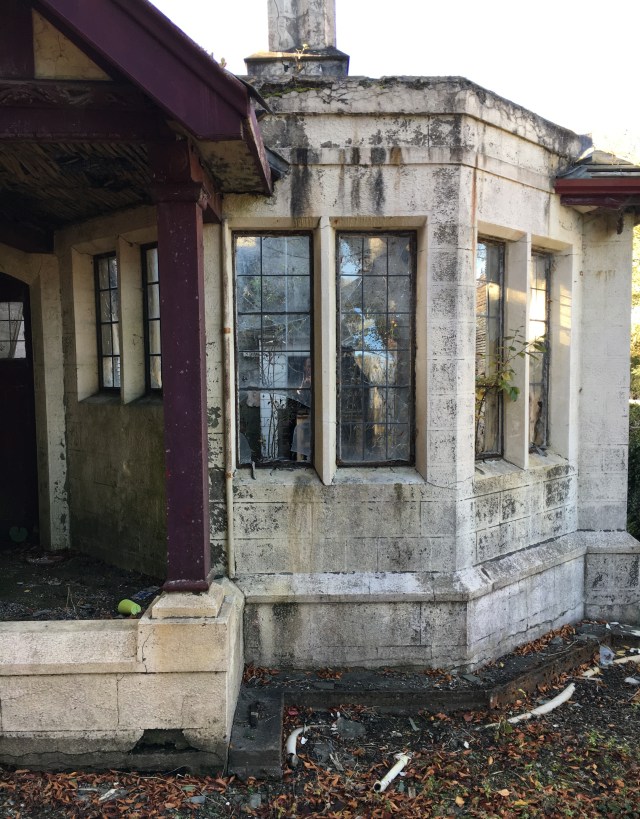
Today’s photographs show what remains of a lodge beside gates opposite Castlecomer Discovery Park. These gates mark the entrance to the now-lost Castlecomer Park, permitted to fall into ruin before being demolished in 1975. It was here that Constance Spry first stayed when she came to the town, the house’s residents being also owners of the local coal mine for some three centuries. The lodge and gates were designed by Dublin architect George Francis Beckett in 1912-13, during the period when Constance Spry was here. More recently the building has been gutted by fire and there is every likelihood it will soon be as little remembered as the exceptional woman who came to the area in 1910 in order to improve the health of the local coal miners.

img_9248

On the Curve

img_1199
The entrance gates to the former Rockbrook estate in County Westmeath. Dating from c.1780 the adjacent lodge has a charming concave exterior wall, pedimented and with one arched window set off-centre. The building behind is ruinous, as is the main late 18th century house formerly occupied by the Isdell family.

img_1201

Change and Decay in All Around I See

img_9513
Readers of a certain vintage may remember a long-running English soap opera called Crossroads in which notoriously the sets were as flimsy as the plots. Set in a midlands motel, the series ran for over twenty years with three or four episodes every week, an astonishing achievement considering how little real drama they ever featured. Yet for much of its history Crossroads regularly attracted audiences of up to 15 million. In 1926 the American journalist H.L. Mencken wrote, ‘No one in this world, so far as I know — and I have searched the records for years, and employed agents to help me — has ever lost money by underestimating the intelligence of the great masses of the plain people.’ The success of Crossroads demonstrates the truth of this observation.

img_9469
fullsizerender4
img_9439
img_9481
fullsizerender2
Today’s building looks as though it could have been constructed for an Irish version of Crossroads. Located in the north-west corner of County Meath, it appears to have been originally a modest farmhouse which was then much-extended to incorporate outbuildings around a central courtyard, the result being a budget hotel with twenty-seven bedrooms and sundry other spaces including a restaurant, bar and conference hall. Everything about the place seems insubstantial and gimcrack, except an enormous Baroque-style sandstone doorcase with open segmental pediment on one side of the property: can this have been salvaged from somewhere else? Is it even Irish? In any case, otherwise the fittings are of poor quality and are correspondingly today in poor condition.

fullsizerender5
img_9485
img_9421
img_9509
img_9482
The hotel closed down some years ago and has since been offered for sale, with the option of alternative use as a residential nursing home. Wandering about the site, it is unclear whether or not a new owner has assumed responsibility for the building, which at present has the eerie atmosphere of a Bates Motel. Neglect has taken its toll on what was never a very robust building and the place reeks of damp and decay. Not quite as flimsy as a Crossroads set, but not much better either: testament to the transitory nature of deficient design and cheap materials.

img_9405


Repair not Restore

img_9740
Last week, a group of graduate scholars and fellows from the Society for the Protection of Ancient Buildings (SPAB) held a meeting in Dublin to propose the establishment of an Irish branch of the organisation. SPAB was founded in England in 1877 by two idealists, the designer and writer William Morris and the architect Philip Webb. They, and other members of their circle, were concerned about what they, often correctly, saw as ill-conceived and over-zealous ‘restoration’ of old buildings, the effect of which was to obliterate much evidence of a property’s cumulative history. This is a situation that has pertained here too, and on occasion continues to do so: for example, a particular moment in a house’s evolution can be selected and anything not relevant to that moment is scrupulously removed. Not only does this have the effect of air-brushing the background, but it often leads to speculative adjustment, to a recreation of what those responsible for the restoration believe would be correct. This is what Morris deemed ‘forgery’, and what he and Webb witnessed happening to buildings across England, especially old churches and cathedrals, and the same ill-advised approach was often adopted here (viz. what happened to both Christchurch and St Patrick’s Cathedrals in the 19th century). Repair not Restore is the motto of SPAB.

img_9721
img_9727
img_9730
Here is the most significant, and most often quoted, section of the manifesto written by William Morris in 1877 to define the purpose and ideology of SPAB: ‘It is for all these buildings, therefore, of all times and styles, that we plead, and call upon those who have to deal with them, to put Protection in the place of Restoration, to stave off decay by daily care, to prop a perilous wall or mend a leaky roof by such means as are obviously meant for support or covering, and show no pretence of other art, and otherwise to resist all tampering with either the fabric or ornament of the building as it stands; if it has become inconvenient for its present use, to raise another building rather than alter or enlarge the old one; in fine to treat our ancient buildings as monuments of a bygone art, created by bygone manners, that modern art cannot meddle with without destroying. Thus, and thus only, shall we escape the reproach of our learning being turned into a snare to us; thus, and thus only can we protect our ancient buildings, and hand them down instructive and venerable to those that come after us.’

img_9723
img_9719
img_9716
There are many merits to the creation of an Irish branch of SPAB, not least the opportunity thus provided to draw on its experience, and the skills of both members and graduates from various programmes run by the organisation. We need more skilled conservators across a range of disciplines, and the training courses run by SPAB are unquestionably of high quality. On the other hand, much of what SPAB does in England is already being done here by a number of existing bodies, and there is the risk of already-scarce resources being further diluted by the entry of another player into the field. Multiplication ought not to lead to duplication. Anyone who attended last week’s inaugural meeting could not fail to be impressed by the ardor and commitment of those who had called it. One of the best features of SPAB is the manner in which it puts ideology into practice, through the organising of various events during which members put their talents to use. Today’s photographs show the kind of property where the intervention of SPAB could make a real difference. The pictures are of a collection of buildings in the yards behind an old house in County Wexford. Various structures have undergone alterations and modifications over time, presumably as their purpose, and the needs of earlier owners, has required. Now they have a special patina that only long and diverse history can convey. Repair not Restore would see these buildings retain that patina, while being given the chance to have a viable future. If SPAB in Ireland can do that here, and in many other places around the country, then its establishment will be of inestimable value to us all.
*Anyone interested in making contact with the advocates of an Irish branch of SPAB, at the moment the best means of making contact appears to be through twitter: @SPABIreland.

img_9732

A Grand and Noble Appearance

img_9234
It is easy to miss Roscommon Castle: despite the building’s immensity, it scarcely seems to impinge on the horizon. Such was obviously not the case when the castle was first constructed, since there would have been nothing of similar scale anywhere in the area. Work was initiated here in 1269 on the instructions of the Anglo-Norman knight Roger de Ufford, who served as Justiciar, or chief governor, of Ireland for Henry III. There were constant setbacks due to attacks on the site by Aedh O’Conor, King of Connacht; it appears the greater part of the castle was erected only in the years following his death in 1274. Originally much of this area was a lake, Lough Nea, and the castle stood on raised ground to the immediate south-east, surrounded by a moat fed by the lake’s waters. A stone wall stood immediately inside this ditch but the main structure was set further back and featured substantial three-storey D-shaped towers at each corner. The main entrance on the eastern side was flanked by three-storey gate houses, and there was a secondary point of access on the western front. Despite impressive fortifications, Roscommon Castle continued to be subject to attack from the native population and by the mid-14th century had passed into the hands of the O’Conors who remained in occupancy there for the next two hundred years.

img_9220
img_9229
img_9232
img_9201
In 1569 the then-O’Conor Don Diarmaid mac Cairbre surrendered Roscommon Castle to Sir Henry Sidney, Lord Deputy of Ireland. Eight years later the building and 17,000 acres were granted by the English government to Sir Nicholas Malby, who was Governor (later Lord President) of Connacht. Malby fundamentally altered the appearance of the castle by transforming it into a Renaissance fortified mansion. The northern side, which had never been of stone, was made into a three-storey domestic dwelling linked to the eastern range to form an L-shaped block: large stone mullion windows were inserted into the upper floors of the latter to admit more light than had hitherto been the case. Within the outer walls a new garden was created. On the northern side, for example, the ditch was turned into a long fish pond while formal geometric parterres were planted to the east and a grand tree-lined avenue to the south. None of these features survive.

img_9129
img_9185
img_9190
img_9155
Sir Nicholas Malby died in 1584, seemingly a disappointed man since he felt slighted by Elizabeth I who had listened to charges of corruption and violence presented by his political opponents. His estate was inherited by a son who is reported as having been slain in a battle against the Irish at Aughrim in January 1603. But even before that date Roscommon Castle had once more been subject to attack, besieged by Hugh O’Donnell for three months in 1596 and again assaulted in 1599. It changed hands on a couple of occasions during the Confederate Wars of the 1640s before being taken by a Cromwellian force in 1652. In the aftermath of this event, some of the defensive features may have been removed but further damage was apparently done to the structure during the Williamite Wars of the early 1690s. Since then it has stood in a state of decay, and today the castle’s appearance is not much different from that described almost 200 years ago by Isaac Weld in his Statistical Survey of the County of Roscommon (1832): ‘It remains merely to say a few words of the general effect of the ruins in a picturesque point of view. From several positions they make a grand and noble appearance, more particularly on the eastern side, where the towers of the portal range in a commanding line with those at the angles…In the evening, when the gleams of the setting sun are seen darting through the ruined casements and narrow loop holes, whilst the main body of the ruins remains involved in deep shade, the effect of the scene is more than usually impressive.’

img_9211

Home of a Hero

img_9032
Buried deep in the undergrowth: the remains of Bellanagare Castle, County Roscommon. This was formerly the seat of the O’Conor family including the antiquarian, proponent of ancient Gaelic culture and ardent advocate of Roman Catholic rights Charles O’Conor (1710-1791) who served as the O’Conor Don (that is, a descendant of the ancient line that provided one hundred Kings of Connacht and eleven High Kings of Ireland). Here he lived until the marriage of his son in 1760 after which he moved to a small cottage nearby. What survives suggests this was a late 17th/early 18th century house, of five bays and with a pedimented façade. Given the importance of Charles O’Conor in Irish history, the building’s present state, on the verge of being entirely overwhelmed by undergrowth, is another sad indictment of how this country treats its heritage.

img_9030

The Deserted Village

img_0657

‘…No more thy glassy brook reflects the day,
But, choaked with sedges, works its weedy way;
Along thy glades, a solitary guest,
The hollow-sounding bittern guards its nest;
Amidst thy desert walks the lapwing flies,
And tires their echoes with unvaried cries.
Sunk are thy bowers, in shapeless ruin all,
And the long grass o’ertops the mouldering wall…’

img_0661
Lines from Oliver Goldsmith’s ‘The Deserted Village’ and photographs of an abandoned village on Achill Island, County Mayo.