Cloverhill House, County Cavan was shown here some months ago (see A Mere Shell, 9th September 2015), a ruin well on the way to vanishing altogether. Happily its entrance is in better condition, a slim, unadorned ashlar triumphal arch flanked by pedestrian gates. The residnce to which it originally gave access was extended by Francis Johnston in 1799, so one imagines the arch dates from the same period. The side gates need to be cleared of overgrowth if they are not to go the way of the old house.
Tag Archives: Stately Home
Attention to Detail

Viewing an old building, one is often so engaged absorbing the totality that details of design can be overlooked. How many visitors to Ballyvolane, County Cork, for example, pay much attention to the stairs? This house, originally built in 1728 by Sir Richard Pyne, was extensively modified in the second half of the 1840s by a descendant, Jasper Pyne. Evidently a new staircase was one of his additions but note how on the side of every tread is affixed a cast-iron putto in each of whose fists can be found a nail holding one of the balusters in place.
Occupational Therapy

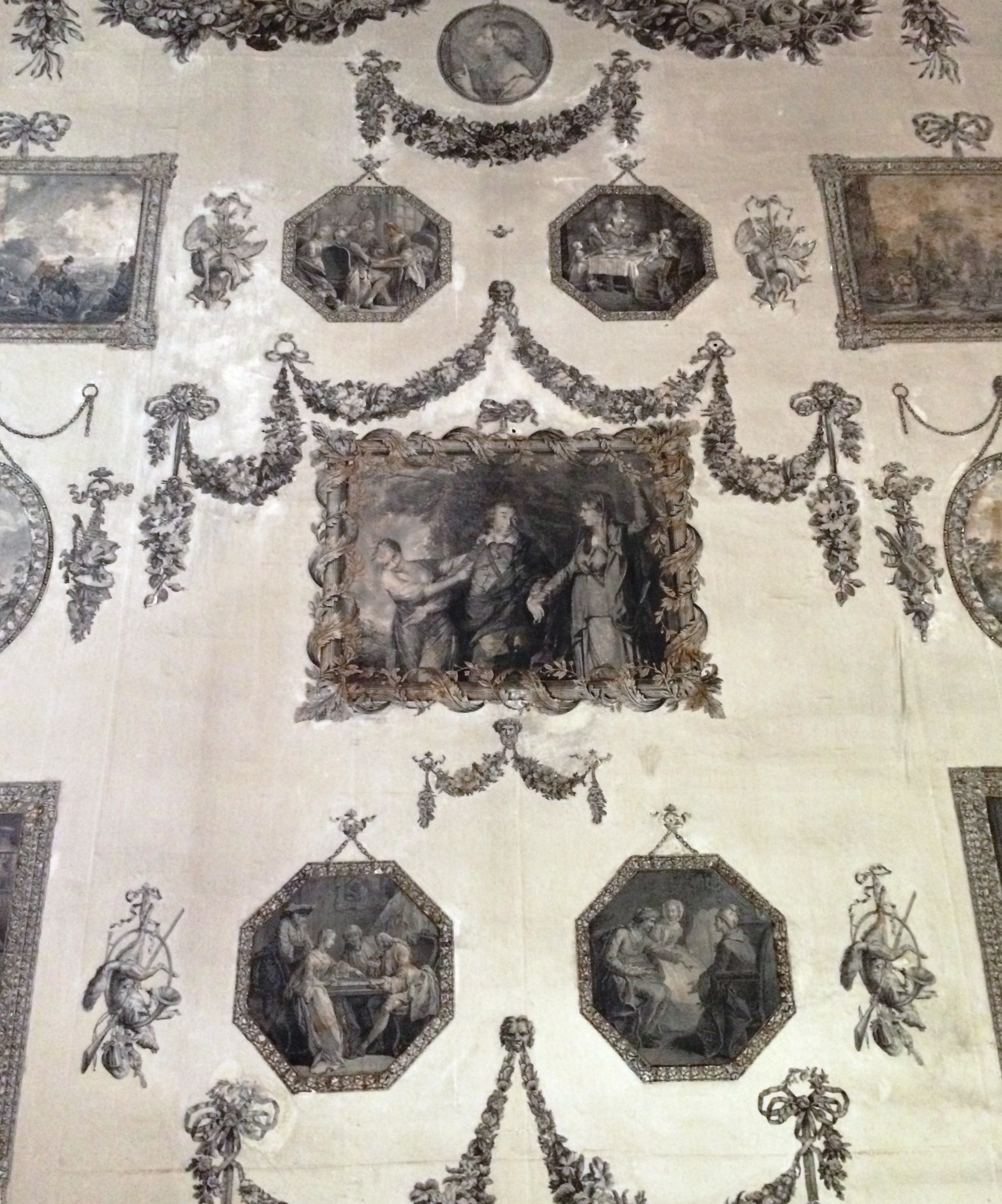
During this post-festive season, when evenings can seem especially long and monotonous, readers might like to consider occupying their time with the creation of a print room. This once-fashionable pursuit, which had its heyday in the second half of the 18th century, subsequently fell out of favour and only one intact example survives in Ireland: that at Castletown, County Kildare. The design and execution of print rooms was customarily left to women, although it evolved from the mostly-male habit of collecting valuable prints and storing these either in a cabinet or within albums. Later on prints might be hung in a chamber designated for the purpose, often kept shrouded in order the work avoided suffering light damage: while cheaper than paintings prints, especially those of larger dimensions could be expensive to produce. However, larger runs of prints in the 18th century, often reproductions of popular works of art, helped to bring down costs and make these pictures accessible to a broader market than had hitherto been the case. Cheaper prices led to greater disposability and the emergence of the print room, a phenomenon effectively unique to Britain and Ireland (although there were some instances of the vogue found in America).


Located behind the house’s main staircase and part of an enfilade on the ground floor overlooking the garden, Castletown’s Print Room was created in 1768 by Lady Louisa Conolly. She had been collecting pictures for at least the previous six years, and in addition had gained experience through assisting in similar ventures with her sister Emily, Countess of Kildare at nearby Carton and with Lady Clanbrassil at Cypress Grove House, Templeogue, County Dublin. Both these rooms have since been lost. The project was a long time in gestation: in 1762 she wrote to her sister Lady Sarah Bunbury, ‘I always forget to thank you my Dear for the Prints you sent me, I hope you got them of Mrs Regnier, for I have a bill there, the two little ones that you admired so, are the very things I wanted, that of Helen is charming. I have not had time to do my Print room yet.’ It is likely the reason the Print Room took so many years coming into existence is both because the Conollys were preoccupied with other work at Castletown and because Lady Louisa did not want to rush preparing the layout of what is a larger space than that customarily used for such a purpose: the ceiling here, for example, is twenty-five feet high. As a result, an awful lot of prints were needed. As late as February 1768 she was still writing to her sister Lady Sarah, ‘…any time that you choose to go into a print Shop, I should be obliged to you, if you would buy me five or Six large Prints, there are some of Teniers engraved by LeBas, which I am told are larger than the common size, if you meet with any, pray send me a few.’ Working out the design for this room was a complex business, particularly since border frames for each of the frames also had to be prepared, as well as garlands, trophies and other elements of the overall decoration.


When Lady Louisa finally came to embark on the scheme, the prints were duly cut out and then glued onto lengths of warm off-white painted paper. These in turn were attached to the room’s walls on battens overlaid with cloth. As Ruth Johnstone has noted, in many cases Lady Louisa ‘made editorial decisions based on the outside shapes of images.’ Accordingly she altered the original rectangular format of forty-six images to either an octagonal, oval or circular shape, or to a rectangle with a convex top. Most likely because of the need to create a visual balance based on size and shape there is no overriding theme to the pictures but rather they reflect mid-18th century taste. A handful of images were included for a specific reason. In central position between the two windows, for example, is a print of Van Dyck’s portrait of the children of Charles I, a group including Lady Louisa’s great-grandfather Charles II. In the same position on the opposite wall is a print taken from Sir Joshua Reynolds’ portrait of Lady Louisa’s sister, the aforementioned Lady Sarah Bunbury (the original painting, incidentally, is now in the collection of Chicago’s Art Institute). Providing a centrepiece on the east and west walls are prints of the era’s most famous actor, David Garrick, and the room also includes a portrait of William Pitt, Earl of Chatham, rather surprising since he was a political opponent of Lady Louisa’s brother-in-law Henry Fox, first Baron Holland. Otherwise the sources were diverse, with a fondness for both pastoral and classical subjects taken from the works of diverse artists including Teniers, Greuze, Jan Steen and Claude Lorrain. Despite such dissimilitude, Castletown’s Print Room conveys an impression of homogeneity thanks to its designer’s careful preparation. Anyone intending to embark on a similar enterprise will find these long winter evenings perfect for similarly thorough planning.

Much more information on Castletown’s Print Room can be found in Ruth Johnstone’s essay on the subject including in the Office of Public Work’s 2011 publication Castletown: Decorative Arts.
Getting Thoroughly Plastered

One of the past year’s most fascinating personal discoveries was the dining room at Altidore Castle, County Wicklow. Often described as a Georgian ‘toy fort’ the house was built c.1730 for General Thomas Pearce, uncle of the architect Sir Edward Lovett Pearce, who may well have been responsible for its design. Much of the interior decoration dates from that period, including the dining room’s panelling. In the last quarter of the 18th century, however, additional ornamentation was added with the introduction of oval and circular plaster medallions featuring female classical deities and graces: this would have been around the period that Altidore was owned by Rev William Blachford, Librarian of Marsh’s Library and father of early Romantic poet Mary Tighe (author of the once-much read Psyche, or the Legend of Love), and subsequently by her brother. During the same period the interiors of nearby Mount Kennedy – designed by James Wyatt in 1772 but only built under the supervision of Thomas Cooley the following decade – was being decorated by the celebrated stuccadore Michael Stapleton. The medallions are not unlike those seen in Lucan House, County Dublin where Stapleton also worked: might he have had a hand in the plasterwork at Altidore?
Welcoming 2016
In New Hands

The 15th century de Burgo tower house which forms the core of Tulira Castle, County Galway. This was one of a number of country houses acquired by new owners during the course of 2015, significant others including Bellamont Forest, County Cavan and Capard, County Laois. But many others remain on the market, such as Milltown Park, County Offaly, Newhall, County Clare, Kilcooley, County Tipperary and Furness, County Kildare, all of which have been discussed here on earlier occasions. Let us hope the coming year is kind to them and all of Ireland’s architectural heritage.
Scouting Around for a Saviour
A week ago the national tourist board, Fáilte Ireland, announced that €60,175 in funding is to be made available to Castle Saunderson, County Cavan. Seemingly this money is part of the organisation’s ‘New ideas in Ancient Spaces’ Capital Grants Scheme for attractions within the Ireland’s Ancient East initiative. The latter scheme was launched by Fáilte Ireland’s last April and ‘seeks to build on the wealth of historical and cultural assets in the east and south of Ireland.’ Leaving aside the fact that Castle Saunderson could never be described as being located in either the east or south of the country (north-midlands might be the simplest summary) one wonders what will be the result of this expenditure. According to Fáilte Ireland, the money ‘will be used to enhance the “on the ground” visitor experience and present the story of Castle Saunderson through the ages. This will be achieved through the development of a new “easy to explore” heritage trail – The Castle Trail. Through interpretative displays, visual art and written interpretation, the story will imaginatively portray the dramatic history and transition of this place as part of Ireland’s Ancient East from free land, through conflict, plantation and the divisive advent of Unionism and the Orange Order to the peaceful coexistence of the present day.’ In other words, the money doesn’t appear to be going towards the restoration of a building on the site which has only fallen into dereliction in the past twenty years and which, with a hint more creativity and resourcefulness, could be restored to serve as a splendid base for the aforementioned ‘on the ground’ visitor experience.


Around the middle of the 17th century the land on which Castle Saunderson stands passed into the hands of one Robert Sanderson whose father, Alexander Sanderson, had come to Ireland as a soldier and settled in County Tyrone. Robert Sanderson had been a Colonel in the army of Gustavus Adolphus of Sweden, and in 1657 served as High Sheriff of County Cavan. On his death in 1675, the estate passed to his eldest son, another Colonel Robert who sat in the Irish House of Commons and married Jane Leslie, a daughter of the Right Rev John Leslie, Bishop of Clogher. The couple had no children and so Castle Saunderson passed to a nephew, Alexander Sanderson. It was the latter’s grandson, another Alexander, who changed the spelling of the family name to Saunderson as part of an ultimately fruitless effort to claim the Castleton peerage of the Saundersons of Saxby, Lincolnshire (the first and last Earl Castleton having died unmarried in 1723). It is his son Francis who is credited with having built the core of the present house. Staunchly anti-Catholic, he is said to have disinherited his eldest son for marrying a member of that faith (or it could have been because she was the daughter of a lodge keeper at Castle Saunderson). So the estate of over 12,000 acres went to a younger son, Alexander. He likewise disinherited his first-born son because he was crippled, and another son who proved rebellious, instead leaving Castle Saunderson to the fourth son, Colonel Edward James Saunderson who, like his forbears, was a Whig politician, and in Ireland leader of the Liberal Unionist opposition to Gladstone’s efforts to introduce some measure of home rule. It appears to have been after the death of his eldest son Somerset Saunderson in 1927 that the family moved out of the house, although they did not sell the property until half a century later.


As has been mentioned, at the core of Castle Saunderson is a classical house built by Francis Saunderson probably around the time of his marriage to Anne White in 1779. In the mid-1830s the building was extensively remodeled in a version of Elizabethan gothic for his son Alexander Saunderson. In December 1835 Nathaniel Clements wrote to Lady Leitrim that he had called by Castle Saunderson where the owner was ‘altering and castellating his house, so I was quite in my element’ The architect responsible for this work is now considered to be George Sudden, who was employed elsewhere in the area, at Lough Fea, County Monaghan and Crom Castle, County Fermanagh, Castle Saunderson displaying certain similarities with the latter (where the original design had been by Edward Blore). This intervention resulted in a bit of a mongrel, the east-facing, two-storey former entrance front retaining long sash windows to either side of a central three-storey castellated tower, its octagonal turrets echoed by lower, square ones at either end of the facade. The north and south fronts are asymmetric, the former having an octagonal entrance tower placed off-centre, the latter featuring a four-bay loggia between two further towers, as well as a substantial service wing at right angles that once incorporated a single-storey orangery. Although unoccupied by the Saundersons, the property was not sold by the family until 1977 when it was bought by a businessman who undertook restoration work. For a period it then became an hotel before being sold again in the 1990s after which fire gutted the house. In 1997 Castle Saunderson and its grounds were acquired by what is now called Scouting Ireland which initially appeared to show interest in restoring the building but eventually chose to construct a new centre elsewhere in the grounds at a cost of some €3.7 million. Meanwhile the old castle has continued to deteriorate: it looks unlikely Fáilte Ireland’s recently-trumpeted initiative will change this situation.
Pure Folly

This seeming folly closes a vista inside the walled garden of Strokestown Park, County Roscommon. In fact the main feature here, the limestone Venetian window, was originally sited on the first floor of the main house and formed part of Richard Castle’s design dating from the 1730s. When Strokestown underwent modifications around 1819 – the architect on that occasion being John Lynn – the window was removed (presumably because a large Ionic portico was added directly beneath) and put into storage. It only found a new home in the walled garden when this was restored in the 1990s.
People in Glasshouses

The roofline of a greenhouse in the walled garden at Tullynally, County Westmeath. Dating from around 1820, it has been built against a brick wall and facing south. Originally used for growing fruit such as peaches and grapes, the building retains its timber frame and fish-scale glass sheets, now something of a rarity in Ireland.
A Generous Welcome to the World

The generous proportions of the front door in the entrance hall at Ballymacmoy, County Cork. Since the early 18th century the house has been home to successive generations of Hennessys, one of whom Richard emigrated to France where he became an officer in the famous Dillon’s Regiment before settling in the Cognac region and founding the eponymous family firm. The present building dates from the second decade of the 19th century, replacing an older property when its excessively heavy slates caused the roof to collapse, killing a pig and a goose, and injuring a beggar who unfortunately happened just then to call to the door.