A Whiter Shade of Pale

IMG_6315

It cannot be claimed that in the 17th and 18th centuries, Ireland’s senior Anglican clergy devoted themselves exclusively to matters religious. Indeed, they were often more preoccupied with politics and the acquisition of material goods than with spirituality, but in at least some instances we are today all the beneficiaries of their activities in these fields. The man who might be said to have set the tone for what followed in the Church of Ireland was Adam Loftus. Born in Yorkshire in 1533, apparently while still an undergraduate at Trinity College, Cambridge he met and impressed Queen Elizabeth and thereafter enjoyed her patronage. Embracing Protestantism, he began to climb through the ranks of the Anglican Church but only really achieved power after serving as chaplain to Thomas Radclyffe, Earl of Sussex following the latter’s appointment as Lord-Lieutenant of Ireland in 1559. By 1561 Loftus was chaplain to the Bishop of Kildare and the same year was appointed to his first living. Thereafter his rise was rapid: in 1563 he was consecrated Archbishop of Armagh at the age of only 28, swapping this four years later for the Archbishopric of Dublin. In 1581 he was appointed Lord Chancellor of Ireland and then strove to ensure that the country’s first university would be located on a site of his choosing: in 1593 he became the first Provost of Trinity College, Dublin, named after his old alma mater. Meanwhile in addition to building up his political as well as ecclesiastical authority, he was acquiring land so as to leave something for his heirs: he and his wife had twenty children, of whom eight died in infancy.

IMG_6219

IMG_6279

IMG_6218

One of the parcels of land which came into Loftus’s possession was located at Rathfarnham at the foothills of the Dublin mountains, confiscated from James Eustace, 3rd Viscount Baltinglass after he had rebelled against the crown. A castle of some kind existed on the site but soon after Loftus was granted Rathfarnham in 1583 at a nominal rent of thirty shillings he began work on a new residence, which remains to the present day. Although the interiors were said to have been luxurious, the castle’s external appearance was very much defensive being rectangular in shape with four massive corner flanking towers to allow guards watch for any approach to the building. Four storeys high,its walls are on average some five feet thick and running east-west through the centre of the entire castle is another wall almost ten feet thick: this seems solid but it is now proposed that in fact the wall actually held a series of chambers or corridors from which access was gained to rooms on either side. Nevertheless, Loftus was right to construct such a solid building since its location left Rathfarnham vulnerable to attack from the Wicklow clans. Five years before his death in 1605 it withstood assault from this source, and did so again during the 1641 rebellion before passing back and forth between different sides in the Irish Confederate Wars. It was only towards the late 1650s that the Loftus family was able to regain control of the place.

IMG_6184

IMG_6216

IMG_6172

In the early 18th century Rathfarnham passed to Philip Wharton, who at the age of 19 was created first (and last) Duke of Wharton by George I; Wharton’s mother had been Lucy Loftus, only child of Adam Loftus, Viscount Lisburne. Wharton seems to have been a hopelessly character. His father Thomas Wharton although notoriously dissipated was at least politically astute and one of the leaders of the opposition to James II. Philip Wharton on the other hand, despite having every advantage, set out on a course of ruination that saw him end his days a hopeless drunk in a Spanish monastery, dead at the age of 32. In 1723 indebtedness caused by over-investment in the South Sea Bubble obliged him to sell his Irish estates including Rathfarnham which was bought by William Conolly, Speaker of the Irish House of Commons. He paid £62,000 for house and lands but never lived there, presumably because he had already begun work on his own house at Castletown, County Kildare (see Up Pompeii, June 17th). Instead the castle was let to various tenants who began to refurbish it before the whole place was sold in 1742 to another Anglican cleric, John Hoadly who had just been made Archbishop of Armagh. On his death Rathfarnham passed to Hoadly’s son-in-law Bellingham Boyle but like Philip Wharton he also suffered from chronic indebtedness and so in 1767 Rathfarnham was sold to Nicholas Hume-Loftus, second Earl of Ely, a descendant of the castle’s original builder. On his death without children it was inherited by his uncle Henry Loftus who also had no issue (compared to their forebear with his twenty offspring, these later Loftuses proved to be an unfecund set) and so Rathfarnham was inherited by a nephew Charles Tottenham who in 1800 would become first Marquess of Ely.

IMG_6179

IMG_6178

IMG_6248

The Elys, who owned several estates, spent little time at Rathfarnham which at some date before 1852 was sold to Francis Blackburne, then Lord Chancellor of Ireland; he and his descendants lived there until 1913 when the place was bought by the Jesuit Order who used it as a seminary and added two long wings on the north- and south-east sides of the main building (they also seem to have taken out the main staircase which is a great shame). The Jesuits in turn put the place up for sale in the mid-1980s when it was bought by a firm of property developers. As the area by this date had become a suburb of Dublin and much of the immediately surrounding land was given over to housing estates, there were concerns that the castle itself would be left to fall into ruin or pulled down. In 1987 the Irish State acquired the building and immediate acreage and under the auspices of the Office of Public Works has been engaged in a process of restoration and refurbishment ever since (see http://www.heritageireland.ie/en/Dublin/RathfarnhamCastle).
There is a great deal more one could write about Rathfarnham Castle, and perhaps might on another occasion. For the present, the accompanying photographs will give an idea of a notable feature of the building which attracts relatively little notice: its fine plasterwork. Throughout the 18th century a succession of different owners and occupiers did much to improve and update the building, and its interiors reflect changes in taste over that period. Different rooms are decorated in different styles, so that the whole castle becomes a history of fashion in stuccowork, ranging from the lightest rococo to severe neo-classicism (both Sir William Chambers and James ‘Athenian’ Stuart had a hand in the design of some of the interiors). All of it is of high quality and serves as an example of the level of Irish craftsmanship – and the ability to adapt to an evolving clientele – throughout the period. It is a pity more is not made of this aspect of the building since Rathfarnham Castle’s diverse decoration gives it a unique character and deserves to be celebrated. Hence the decision to feature only details of the house’s plasterwork today.

IMG_6198

Next Saturday morning, I shall be speaking about Adam Loftus, as well as many of his successors, in the course of a talk entitled ‘Building Bishops: Architectural Ambitions among 18th Century Irish Clergy’ at the Roe Valley Arts and Cultural Centre in Limavady, County Derry as part of a three-day conference devoted to Frederick Hervey, the great Earl-Bishop of Derry. For more information about this event, see: http://www.herveysummerschool.com/

Knock Knock

IMG_5427

IMG_5453

The popularity of the gothic style for domestic buildings in early 19th century Ireland owed something to a desire among landed families to suggest longer residence here than was often actually the case. The Levinges, for example, only came to this country in the aftermath of the Williamite Wars when the Derbyshire-born lawyer William Levinge was appointed Irish Solicitor-General and Speaker of the House of Commons; he later became Attorney-General and Lord Chief Justice. As a reward for his services, in 1704 he received a baronetcy and duly became Sir Richard Levinge of High Park in the County of Westmeath.
Today the property is known as Knockdrin, built close to a late mediaeval castle once belonging to the Tuite family; it was their lands that Sir Richard acquired and on which he built a new house. However by the early 19th century this had fallen into disrepair and so the sixth baronet, also called Sir Richard Levinge, embarked on a rebuilding programme that would give him a splendid gothic castle and all the links with an ancient past this implied.

IMG_5406

IMG_5402

IMG_5408

It is not known for certain who was responsible for the design of Knockdrin Castle. Sir Richard Morrison produced a design for the entrance front but while elements of this were incorporated into the eventual building it cannot be attributed to him. Instead Knockdrin is assigned to James Shiel, believed to have trained in the office of Francis Johnston an architect who created some of the finest gothic revival castles in Ireland, not least Charleville, County Offaly. Like Charleville, Knockdrin’s late-mediaeval trappings are lightly worn: this is essentially a Georgian country house in fancy dress. The entrance front presents a degree of asymmetry, primarily thanks to a long castellated curtain wall leading to a two-storey gatehouse providing access to the service courtyard. But the battlemented main block, of rubble limestone with dressed window surrounds and featuring a wide fanlit doorway flanked by square towers, has only superficial quirks, such as a slim turret on the south corner. And notice how standard rectangular sash windows are used on the upper storeys.

IMG_5380

IMG_5377

IMG_5390

A similarly familiar sense of order can be found inside where once more the usual forms are followed, albeit decked out in gothic flummery. As in so many Irish houses the rear of the entrance hall has a screen but in this instance it is composed of three pointed arches supported on slender cluster-shafted columns. Doors to either side open onto the library and dining room (the latter now regrettably divided in two). But another door provides access to Knockdrin’s most striking feature: a top-lit staircase with the stairs (like the doors throughout the building) made of carved oak. The elaborate first floor is decorated with a gallery of fluted shafts and sequence of ogee-headed niches around the walls. Abundant light provided by a central glazed dome helps to create a fluid, elegant space possessing none of the heaviness customarily associated with the Gothic Revival movement. On the other hand, despite high ceilings emblazoned with plasterwork of Tudor roses and the like, the enfilade of ground floor reception rooms – ballroom, drawing room, library – is less distinguished, although a line of full-length, south-facing windows means that like the staircase hall they are exceptionally bright.

IMG_5350

IMG_5340

IMG_5342

Knockdrin remained in the possession of the Levinge family until the last century. Within weeks of the outbreak of the First World War the tenth baronet, another Sir Richard Levinge, was dead after being hit in the neck by a bullet as he walked along a trench at Ypres. His widow and only son moved to England and the house was let to various tenants; at one point it served as a school and in the early 1940s was occupied by members of the Irish army who inevitably inflicted a certain amount of damage on the building. Finally in 1943, the greater part of the estate having already been broken up by the Land Commission, the castle and surrounding land was sold by the Levinges, thereby ending a link of almost 250 years. The present owners bought the place in 1961 and have cared for it ever since. One should not try to make exaggerated claims for Knockdrin. It is certainly not a house of the first importance, but can be considered noteworthy as an example of the transition from classicism to gothic, when the latter was still a style and not yet an ideology and the former’s principles survive beneath a veneer of ornamentation. Below is a portrait of Sir Richard, the sixth baronet who commissioned the house. The picture was painted by the minor English artist Thomas Shew in 1828 and includes a view of Knockdrin, presumably imaginary since Shew never came to Ireland.

IMG_5393

IMG_5417

Abbey Road

15

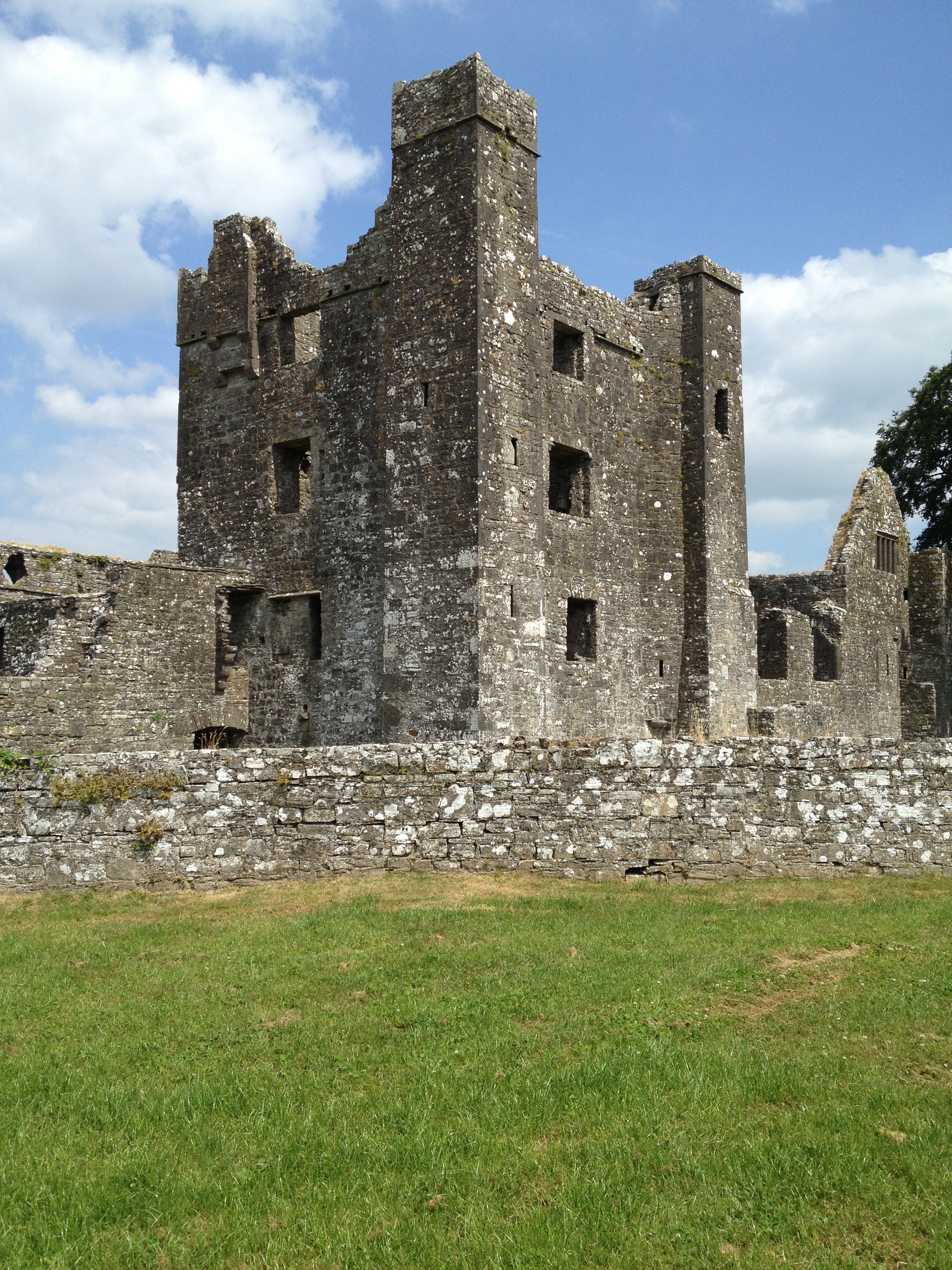
In 1142 St Malachy of Armagh was responsible for founding Ireland’s first Cistercian monastery at Mellifont, County Louth. Five years later a small group of this house’s residents walked some 35 miles to establish a second monastery close to the banks of the Boyne river at Bective, County Meath. Built on land granted by Murchadh O’Melaghlin, King of Meath the new monastery was dedicated to the Virgin Mary and quickly grew into a thriving community. Half a century after its foundation, such was the importance of Bective Abbey that in 1196 the body of the Anglo-Norman Lord of Meath Hugh de Lacy was interred here; it was later moved to St Mary’s Abbey in Dublin. By the start of the following century Irish Cistercians would appear to have slipped into laxness; attempts by the church authorities to initiate a programme were rebuffed, not least by the Abbot of Bective who in 1217 participated in a ‘riot’ at Jerpoint Abbey, County Kilkenny and was further charged with imprisoning a man in a tree stump until he died. The Abbot was subsequently sent to Clairvaux in France for trial and prior of the Norman Abbey of Beaubec appointed to take responsibility for Bective.

2

13

8

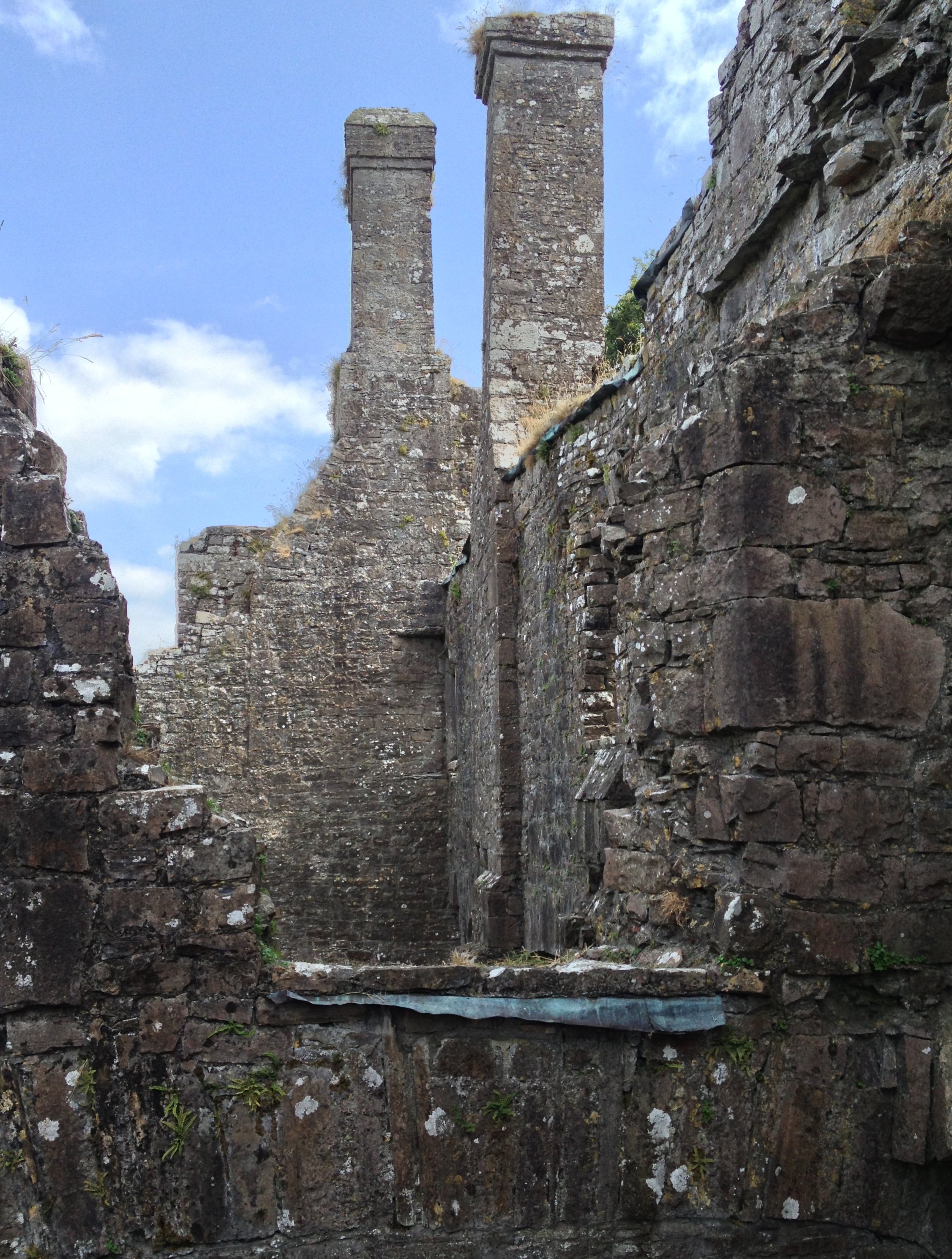
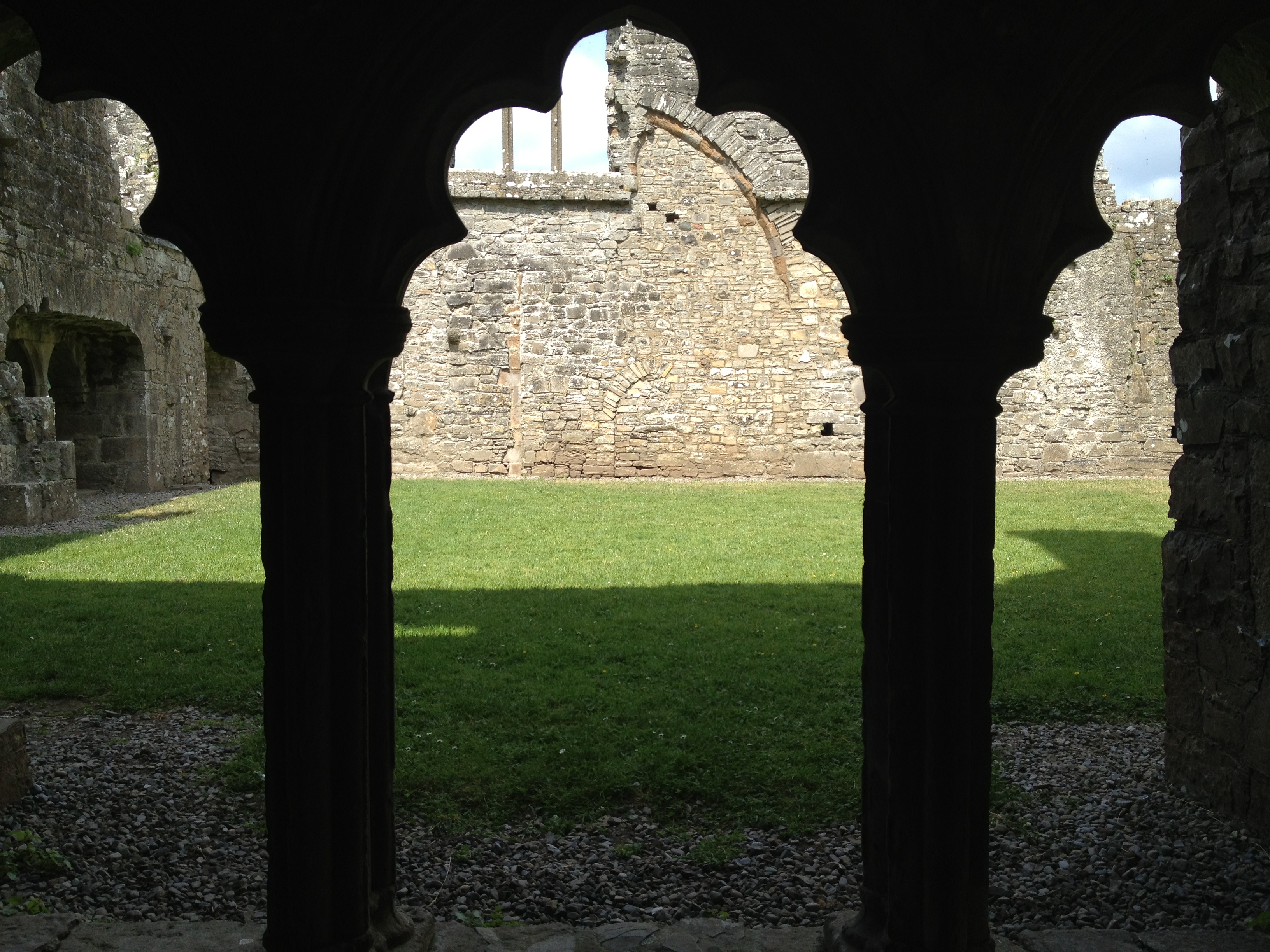
Nothing remains of the original monastic establishment at Bective; the earliest part of the present range of buildings dates from the 12th – 13th century buildings and include there remain the chapter house on the south-east side, a plain rectangular building with central column, also part of the west range and fragments of the aisled cruciform church. By the 15th century a serious decline in numbers had occurred and the premises were reduced in size. The church, for example, was substantially shortened and its south aisles demolished which in turn blocked off the adjoining arcades. Massive fortified towers were erected on the church’s west façade and on the south-west corner of the monastery, giving Bective the appearance more of a castle than a religious establishment. The most striking feature to the modern eye is the cloister that was built at this time, smaller than its predecessor (measuring no more than 33 feet square) and now the best-preserved Cistercian cloister in Ireland. The passages are set not beyond the walls but within them and are thus recessed, with each arcade composed of three miniature arches supported by double-column shafts. In one instance a panel between inner and outer shaft is decorated with the carved figure of an unidentified cleric set into an ogee-headed niche with his arms including three fleur-de-lys (see the top-most picture for a detail of this feature).

12

16

5

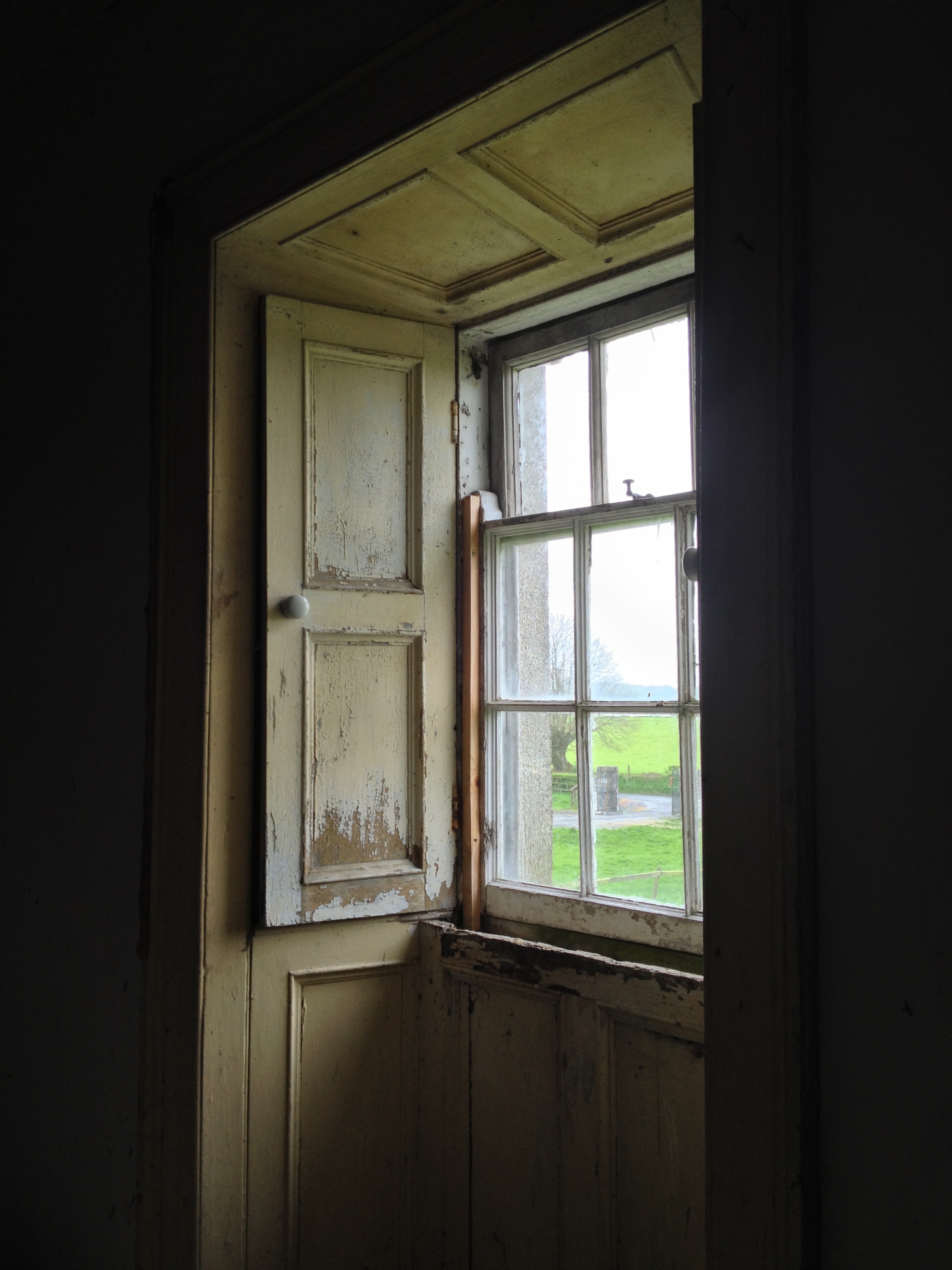
Despite having fewer occupants, Bective Abbey remained a considerable land owner; at the time of the dissolution of the monasteries in 1537, this establishment was recorded as possessing a total of 4,400 acres in Meath. And the land was of high quality, so there was no shortage of lay people eager to acquire it, beginning with the Staffordshire-born Thomas Agard who came to Ireland in the crown service and charged with the task of assessing the country’s mineral resources and the possibility of developing lead mines. He began the process of converting the former monastery into a domestic residence, with the cloister transformed into an internal courtyard and the refectory turned into a Great Hall. Larger openings were inserted to create windows and tall chimneys rose above the roofline. After Agard’s death house and estate were briefly owned by Ireland’s Lord Chancellor John Allen before being bought in 1552 by Andrew Wyse, Vice-Treasurer of Ireland for £1,380 16s 7d. It passed through a couple of generations of his family but already by 1619 the abbey was described as being deserted. Twenty years later the property came into the possession of Sir Richard Bolton, like Agard originally from Staffordshire but by this date Lord Chancellor of Ireland. The estate remained in the possession of the Boltons for the next two centuries although they usually rented it out and by 1800 had built Bective House on the other side of the Boyne. In 1884 Bective was inherited by the Rev. George Martin, Rector of Agher, County Meath and ten years later he vested the abbey ruins to the Board of Public Works. It has remained in state ownership ever since but has recently been made more accessible than hitherto the case. The surrounding flat land and its high towers make Bective Abbey easy to spot and since access to the site has recently been improved exploration of this wondrous relic of late-mediaeval/early modern Irish architecture is a delight.

17

Decorative Dining

IMG_4270

A detail of the plasterwork around a door leading from dining room to drawing room at Ballinlough Castle, County Westmeath. This extension to the much earlier house dates from c.1790, its design generally attributed to the amateur architect Thomas Wogan Browne. Browne also undertook similar work at Malahide. where the chatelaine Margaret Talbot was sister to Ballinlough’s then-owner Sir Hugh O’Reilly. The style is an eclectic blend of classical and gothic, and yet the assured delicacy with which it is applied (who can resist an ‘eggcup’ urn perched atop the pilaster) makes the result irresistible. As for Browne, he died – seemingly by his own hand – in 1812, two years after which his brother sold the family estate in County Kildare to the Jesuit order; ever since it has been a boarding school for boys known as Clongowes Wood College.

Pyra-Mania

IMG_4526

Dense with blossoming pyracantha, this section of the yard behind Huntington Castle, County Carlow has been converted into a picturesque residence. Home to the Durdin-Robertson family (members of which created a Temple of Isis in its basement in the 1970s), Huntington’s core is a tower house dating from 1625 but it has been much altered and enhanced ever since, not least by the addition of battlements in the 19th century so that it has an exceptionally pretty toy-like exterior. The gardens include a yew walk believed to be at least 600 years old.

An Irishman’s Home is His Tower House

image

All across Ireland can be seen buildings commonly known as castles but which ought more correctly be called tower houses. The tower house is not exclusive to this country, similar structures being found along the Scottish Borders. However, the sheer quantity of these edifices make them one of the most distinctive features of the Irish landscape: it has been estimated that between 1400 and 1650 in the region of 3,000 tower houses were constructed.
A statute issued by Henry VI in 1429 declared, ‘It is agreed and asserted that every liege man of our Lord, the King of the said Counties, who chooses to build a Castle or Tower House sufficiently embattled or fortified, wither the next ten years to wit 20 feet in length, 16 feet in width and 40 feet in height or more, that the commons of the said Counties shall pay to the said person, to build the said Castle or Tower ten pounds by way of subsidy.’ It is often proposed that this piece of legislation, with its financial incentive, did much to encourage the popularity of tower houses, and also their uniformity of design.

image

image

There is some dispute whether the tower house’s primary purpose was defensive or residential; one suspects it varied according to geographic and political circumstances. Typically the building is rectangular and constructed of irregular stones, the walls in excess of four feet thick at base level and rising four or five storeys high. A single arch doorway offered admission with the large arched ground floor devoted to diverse purposes including storage of foodstuff and livestock. Above the entrance was an opening called the Murder Hole, through which boiling liquids or arrows could be directed in the event of an attack. Windows at this level were little more than slits although they were larger further up. The family lived on the tower’s top storeys, but levels of comfort were pretty minimal.
Various descriptions of life in a tower house have come down to us and none of them make it sound especially luxurious. For example the Spaniard Cuillar wrote in 1588 ‘The Irish have no furniture and sleep on the ground, on a bed of rushes, wet with rain and stiff with frost…’ Half a century later the French traveller, M. de la Bouillaye le Gouz observed ‘The castles of the nobility consist of four walls, extremely high and thatched with straw but to tell the truth, they are nothing but square towers without windows or at least having such small apertures as to give no more light than a prison. They have little furniture and cover their rooms with rushes, of which they make their beds in Summer and straw in Winter. They put rushes a foot deep on their floors and on their windows and many of them ornament their ceilings with branches.’

image

image

In many respects Kilbline Castle, County Kilkenny is a typical Irish tower house. Rising five storeys high, it has round bartizans or wall-mounted turrets at each corner of the east front and a slender chimney-stack between them. The surrounding bawn wall survives in part but some sections were demolished in the last century to permit the erection of modern farm sheds. Kilbline is usually dated to the 14th/15th centuries but a large limestone chimneypiece on the first floor carries the date 1580 so it is possible that was when the building was completed. On the other hand, there is reference to Kilbline Castle being forfeited by one Thomas Comerford of Ballymac in 1566 so perhaps the chimneypiece was inserted into the tower by its subsequent owner.
That person may have been a member of the Shortall family of Rathardmore Castle in the same county. Thomas Shortall of Rathardmore died in 1628 and not long after his heir Peter moved to the castle of Kilbline, where he subsequently lived. His estates, which ran to some 1,500 acres were declared forfeited by the Cromwellian government in 1653 and his sons ordered to be sent to Connaught, although one of them seems to have returned to Kilbline, perhaps after the restoration of Charles II in 1660. Nevertheless, Kilbline once more changed hands during this period.

image

image

Originally from Newcastle in Northumberland, William Candler is believed to have served as an officer in Oliver Cromwell’s army during the Irish wars of 1649-53. As a reward for his endeavours, he was promoted to the rank of Lieutenant Colonel and granted lands in County Kilkenny, including those on which stands Kilbline Castle. He and his wife Anne Villiers had two sons, the younger of whom John is known to have lived at Kilbline. John Candler had a single son Thomas who, in turn, had only the one child, Walsingham; he never married and so that line of Candlers came to an end.
To return to Lt.Col. Candler, his older son Thomas who lived at Callan Castle had four sons, the youngest of whom Daniel caused a rumpus within the family by marrying an Irishwoman, possibly a Roman Catholic, called Hannah and as a result was obliged to leave first County Kilkenny and then Ireland. Around 1735 Daniel and Hannah Candler moved to the America Colonies, initially settling in North Carolina before they moved to Bedford, Virginia. Their great, great, great-grandson was Asa Griggs Candler, the entrepreneur who in 1888 bought the formula for Coca Cola and made himself fabulously rich as a result.

image

image

Kilbline Castle continued to be occupied until just a few decades ago. At some point, probably in the 19th century, a two storey three-bay house was added on the west end of the tower house and a further single storey structure abuts this. The interior of the house remains relatively intact and suggests a degree of affluence on the part of the occupants.
However, the most architecturally significant feature of Kilbline is a wonderful panelled room on the south-east corner of the ground floor. Most likely of oak (it was hard to tell with certainty) this looks to date from the late 17th or early 18th centuries and must therefore have been created while the building was occupied by the Candlers. Although the ceiling is now covered in tongue-and-groove boards, all the wall panelling is intact, as is the old chimneypiece (the latter marred only by a shelf added at some later date). This rare instance of early Irish interior decoration is some 300 years old and given that the house has been empty for some time it remains in remarkably good condition, as can be seen in the pictures above. The present owners, although they do not live in the building, are aware of its importance and would dearly love to restore Kilbline and ensure its future.

image

Killeen with Kindness

40 Plunket A

A watercolour of Killeen Castle, County Meath, painted by Lady Emma Frances Plunkett (1826-1866), daughter of the ninth Earl of Fingall. The Plunketts are of Norman origin and established themselves in this part of Ireland at the end of the 14th century. The Earls of Fingall were notable for remaining Roman Catholic throughout the Penal era, unlike their neighbouring cousins, the Lords Dunsany who converted to Anglicanism. The picture is significant because it shows Killeen prior to extensive changes made to the structure from 1841 onwards by Lady Emma’s father, in other words it must have been painted while she was still an adolescent. At the age of 24 she married William Ince Anderton, member of an old Lancashire recusant family and together they embarked on the construction of a new chapel on his estate at Euxton Hall to the designs of Edward Welby Pugin; following Lady Emma’s death in 1866, a large stained glass window was installed in the chapel which shows her kneeling at the foot of the cross.
Killeen remained in the ownership of the Plunkett family until it was sold by the twelth and last Earl of Fingall in 1951. Thirty years later, after changing hands a couple of times more, the castle was gutted in an arson attack. It then stood ruinous until the estate was bought in 1997 by a development company which undertook to restore the building as centrepiece of a luxury hotel and spa. The rest of the same organisation’s scheme, including the inevitable championship golf course and series of commuter houses went ahead but of course the castle’s restoration stalled: when I visited some years ago, the roof had been repaired and concrete floors installed but little further work undertaken. Below is another watercolour by Lady Emma Plunkett, this one showing Dunsany Castle which happily remains intact and in the ownership of its original family. Both pictures, and three more by the same amateur artist, are included in an exhibition opening next week in Dublin’s Gorry Gallery (see http://www.gorrygallery.ie).

38 Plunket A

With Good Grace

IMG_0775

Lying in the shadow of the Knockmealdown Mountains, Castle Grace, County Tipperary is believed to have been built by the de Bermingham family around the mid-13th century. Its substantial square keep originally had a tower at each corner but only the two seen here remain. Today the ruins serve as a walled garden for an adjacent mid-19th century house, about which more later in the spring.
If Castle Grace looks familiar, this is because it appeared in Stanley Kubrick’s incomparably beautiful 1975 film Barry Lyndon. The relevant scene: after our eponymous anti-hero has fled his home, been robbed at gunpoint and forced by penury to join the army, he camps here and engages in a bare-knuckle fight with one of his fellow soldiers.

IMG_1034
Apologies for the poor quality screen grab: with good reason this blog is called The Irish Aesthete and not The Irish Techno-Wizard.

Worth a Squint

IMG_0286

Delvin, County Westmeath is one of those small Irish towns through which it is easy to pass without paying attention to the place. In other words, except for residents it is never a point of destination. This is regrettable, because Delvin does have interest, although – again like so many small Irish towns – first impressions would not indicate that to be the case. Essentially a single straggling, untidy street Delvin lacks coherence and order, lacks the kind of communality of vision and presentation that make its equivalents in other countries so satisfying. The town has some fine buildings – there are a number of pretty early 19th century houses – but just as many, if not more, that destroy whatever chance Delvin might have of detaining visitors.
Those prospective visitors would be interested to know that among the reasons they should linger is the town’s appearance in a novel which caused a sensation almost a century ago. Published in 1918, The Valley of the Squinting Windows was written by Brinsley MacNamara (1890-1963), the pseudonym of a local man, John Weldon whose father James was principal of a national school elsewhere in the county. The book is a rather overwrought tale of a young teacher seduced by a wealthy, dissipated man and how a trainee priest who has fallen in love with her avenges this outrage. It owes more to 19th century melodrama than 20th century realism, and is closer in spirit to Peyton Place than to Madame Bovary, the latter presumably being what MacNamara had hoped to emulate.

IMG_0290

IMG_0274

The Valley of the Squinting Windows would likely be forgotten now but for the stir it caused on publication in Delvin. MacNamara always claimed that Garradrimna, the village in his novel, was representative of any small community in Ireland: ‘I used certain descriptions of characters and events because they were typical, were easily identified with local people and happenings. But people in Clare and Limerick have been able to do exactly the same in the case of their own villages. So could people in any county in Ireland.’ However, Garradrimna’s topographical details fix it so precisely as Delvin that locals understandably took umbrage, especially as there are really no attractive characters in the book, everyone being small-minded and greedy, obsessed with discovering and relishing the misfortunes of their neighbours. Seemingly when the novel was published there was great excitement in the region but this quickly changed to indignation once its contents were known: obviously no one thought to notice the title provided a fair warning of what lay inside. Instead of sensibly allowing the work slip into oblivion, the people of Delvin publicly burnt a copy in the centre of the village. Worse, they organised a boycott of children attending James Weldon’s school, as though he were responsible for his son’s novel. In response, Weldon brought a law suit for £4,000 against Delvin’s parish priest and seven parishioners for arranging the prohibition. He lost the case and was forced to emigrate. The Valley of the Squinting Windows has ever since been synonymous with small town pettiness.

IMG_0271

IMG_0277

Among the features of Garradrimna that made it easily identifiable as Delvin are several references to a de Lacy castle at one end of the village. Just such a structure remains in place to this day, popularly believed to have been built by the Norman soldier Hugh de Lacy who came to Ireland with Henry II in 1171 and over the next 15 years erected many such structures in this part of the country. Delvin Castle is supposed to date from a decade later, after which it was given to de Lacy’s son-in-law, Gilbert de Nugent whose descendants, later Earls of Westmeath, remained in the area until 1922. Originally a massive keep with four circular corner turrets, the castle is now only half its former size, the north wall having long since gone. The owner of the abutting corner house told me his grandmother who used to live there, on being informed she was responsible for the castle and its upkeep, handed the property over to the Office of Public Works, which seems to have done little since.
Nearby, and even more dejected in appearance, is St Mary’s, the former Church of Ireland church which incorporates a mid-16th century belfry into an otherwise predominantly early 19th century building. Deconsecrated and unroofed in 1963, the building and graveyard have recently undergone refurbishment at the hands of industrious residents, which was necessary for its well-being but has had the unintentional effect of removing much of the site’s romantic charm.

IMG_0264

IMG_0266

Goodness knows, otherwise romantic charm is hard to discover in Delvin; opposite the stretch occupied by castle and church, for example, a large site is occupied by a private house presumably dating from the 1970s, never attractive and now an derelict eyesore.
At the other end of the town stands the Roman Catholic Church of the Assumption, unlike its Anglican counterpart still very much in use, designed by George Ashlin in 1873 and described by Christine Casey and Alistair Rowan as ‘an accomplished small-scale essay in French Gothic’, although one imagines the French original would not be surrounded by quite so much tarmac. In fictional guise it also appears in The Valley of the Squinting Windows.
MacNamara had little good to say about Garradrimna/Delvin, damning not just the local populace but also the physical appearance of the village itself, describing it as mean and fly-blown, with ugly houses. No doubt the resident population today is quite different to that he castigated: there is even an annual Delvin Garradrimna Book Fair. But it remains the case that the novel was as much a condemnation of place as people. MacNamara’s observations on how Delvin looked – and still looks – have yet to be addressed. If that happened, even visitors unfamiliar with The Valley of the Squinting Windows would be encouraged to linger for longer than is now the case.

IMG_0292