Then & Now


‘A little before dinner I got to Castle Ward. Lord Bangor received me with great cordiality, brought me into his room, and signed the address with great willingness. He also asked me to dine and stay all night. This was the greater compliment as his house was full of company and not quite finished…There was an elegant dinner, stewed trout at the head, chine of the beef at the foot, soup in the middle, a little pie in the middle of each side, and four trifling things in the corners, just as you saw at Mr Adderley’s. This is the style of all the dinners I have seen, and the second course of nine dishes made out much in the same way. The cloth was taken away, and then the fruit – a pine-apple (not good), a small plate of peaches, grapes and figs, (but a few) and the rest pears and apples. No plates or knives given about. We were served in queenware.
Our epergne, candlesticks, service of china, variety of fruit, substantial and well-dressed dinners and dining-room far exceed anything that I have seen since I came abroad, and so it is spoken of, for Miss Murray assured me in the most serious manner that both Sir Patrick and Fortescue had often declared that they never had anywhere in their lives met with so much entertainment, with a more convenient house, or more elegant living than at Castle Caldwell.’
Sir James Caldwell, writing to his wife, Monday, 12th October, 1772


‘August 11th, 1776. Reached Castle Caldwell at night, where Sir James Caldwell received me with a politeness and cordiality that will make me long remember it with pleasure…Nothing can be more beautiful than the approach to Castle Caldwell; the promontories of thick wood which shoot into Lough Erne, under the shade of a great ridge of mountains, have the finest effect imaginable; as soon as you are through the gates, turn to the left, about 200 yards to the edge of the hill, where the whole domain lies beneath the point of view. It is a promontory three miles long, projecting into the lake, a beautiful assemblage of wood and lawn, one end a thick shade, the other grass, scattered with trees and finished with wood…the house, almost obscured among the trees, seems a fit retreat from every care and anxiety of the world; a little beyond it the lawn, which is in front, shews its lively green among the deeper shades and over the neck of land, which joins it to the promontory of wood called Ross a goul, the lake seems to form a beautiful wood-locked bason, stretching its silver surface behind the stems of the single trees; beyond the whole, the mountainy rocks of Turaw give a magnificent finishing…Take my leave of Castle Caldwell, and with colours flying and his band of music playing, go on board his six-oared barge for Inniskilling; the heavens were favourable, and a clear sky and bright sun gave me the beauties of the lake in all their splendour.’
From Arthur Young’s Tour of Ireland 1776-1779


‘I travelled four hundred miles de suite without going to an inn. Amongst those who were most desirous of my calling upon them was Sir James Caldwell, of Castle Caldwell, on Lough Erne. One anecdote will give some idea of his character. The Marquis of Lansdowne, then Earl of Shelburne, being in Ireland, and intending to call on Sir James, he, with an hospitality truly Irish, thought of nothing night or day but how to devise some amusement to entertain his noble guest, and came home to breakfast one morning with prodigious eagerness to communicate a new idea to Lady  Caldwell. This was to summon together the hundred labourers he employed, and choose fifty that would best represent New Zealand savages, in order that he might form two fleets of boats on the Lough, one to represent Captain Cook and his men, the other a New Zealand chief at the head of his party in  canoes, and consulted her how it would be possible to get them dressed in an appropriate manner in time for Lord Shelburne’s arrival. Lady C, who had much more prudence than Sir James, reminded him that he had 200 acres of hay down, and the preparations he mentioned would occupy so much time that the whole would now stand a chance of being spoiled. All remonstrances were in vain. Tailors were pressed into his service from the surrounding country to vamp up, as well as time would permit, the crews of men and fleets. The prediction was fulfilled: the hay was spoiled, and what hurt Sir James much more, he received a letter from Lord S. to put off his coming till  his return from Kilkenny, and that uncertain.’
From The Autobiography of Arthur Young (published 1898)


Today’s photographs show the now-scant remains of Castle Caldwell, County Fermanagh. 

Accidents Happen


Eight years ago, the Irish Aesthete wrote about the Volunteer Arch at Lawrencetown, County Galway (see: Gateway to the New Year « The Irish Aesthete). As was explained then, this monumental gateway was built in 1782 as the principal entrance to an estate called Bellevue owned by Colonel Walter Lawrence, an ardent supporter of the Volunteer movement and of Henry Grattan’s efforts to achieve greater legislative independence for the Irish parliament. Following the realisation of the latter ambition, the colonel erected this arch which consists of a main entrance flanked by smaller openings which in turn are connected to two-room lodges. The entrance is surmounted by a pediment topped with an urn and with a carved medallion beneath, while sphinxes rest on either side. A recessed panel directly beneath the pediment bears a Latin inscription which translated reads ‘Liberty after a long servitude was won on the 16th April 1782 by the armed sons of Hibernia, who with heroic fortitude, regained their Ancient Laws and established their Ancient Independence.’ The arch was restored some years ago, not least thanks to the efforts of a local voluntary group, but what was once the private entrance to an estate is now a public road and in consequence the structure recently suffered serious damage, as can be seen in the images below: these suggest that a tall vehicle collided with the upper section of the arch, knocking out the keystone and thereby rendering the whole thing vulnerable to collapse. Since it is listed for protection, the local authority has, it seems, committed to carrying out necessary repairs, and these need to be undertaken sooner rather than later if the arch is to survive. But just as importantly, some protective bollards need to be erected in its immediate vicinity, and perhaps something discreet to moderate the height of vehicles passing under the arch. Otherwise this will remain an accident waiting to happen again.


Photographs by George Gossip

Silent Witness


Considering the impact he had on this country, it is surprising that the name of architect George Wilkinson is not better known here. Born in Witney, Oxfordshire in 1814, and the eldest of six children, Wilkinson’s background was modest: his father was a carpenter and builder. There is little known of his education or training but he soon began to win contracts for work and in 1839 – when still not yet 25 – was appointed architect to the Irish Poor Law Commission, of which more below. Wilkinson thereafter spent the greater part of his life in Ireland, only returning to England a few years before his death in 1890. While living here, aside from his work for the commission, he was responsible for designing many other buildings, not least railway stations, perhaps the most celebrated of these being that on Harcourt Street in Dublin, as well those in Cavan and Sligo towns, Bray, County Wicklow, Athlone, County Westmeath, and Carrick-on-Shannon, County Leitrim, among many others. He designed the fine redbrick offices for the Guinness brewery at St James’s Gate in Dublin, and district lunatic asylums in Castlebar, County Mayo, Letterkenny, County Donegal, and both Carlow and Limerick. His practice in Ireland was extremely and consistently busy but it began with a large number of buildings which continue to have a notoriety here: workhouses.



In Ireland, workhouses are today associated with the catastrophe of the Great Famine and its aftermath. However, as institutions they neither originated in this country, nor were they intended to deal with such a disaster. The workhouse was essentially an English construct, arising out of successive Poor Law Acts and specifically dating back to the 1720s when legislation was passed allowing a local parish either to purchase or rent a property ‘for the Lodging, Keeping and Employing of poor Persons.’ Here in Ireland, and some twenty years earlier, a ‘House of Industry’ was established by act of Parliament in St James’s parish, Dublin ‘for the employment and maintaining of the poor thereof’: in 1729, it also became a Foundling Hospital. Operational costs were covered by, among other things, a tax on sedan chairs and hackney coaches. In 1773 a similar House of Industry was set up across the other side of the Liffey, on what is now North Brunswick Street. Others followed in a number of Irish cities and towns including Cork, Belfast, Limerick, Waterford and so forth. Like their English equivalents, these buildings were never supposed to be an attractive option: they were intended to be places of last resort for those who were destitute and prepared to suffer what could be a harsh regime (in England the running of many workhouses was contracted out to third parties: shades of direct provision centres in this country at present). Circumstances, both in England and here, began to change in 1832 when the Westminster Parliament established a Royal Commission, chaired by the Bishop of London, to look at the administration of existing Poor Laws, some of them going back to 1601, and see how these might be improved. A report delivered two years later led to the 1834 Poor Law Amendment Act, which created a new administrative framework for providing relief to the poor, operated by a Poor Law Commission. One of the latter’s first tasks was to disband the old parish-level system of support and replace it with a nationwide series of organisations called Poor Law Unions, each run by a locally elected Board of Governors. Each union was to have its own workhouse, funded by a local poor rate. Workhouses were deeply unpopular in England and Wales, where they were first constructed, and often subject to attacks; some were even threatened with arson. Nevertheless, a similar system was proposed for Ireland by the government and in 1833 another commission, this one chaired by the Archbishop of Dublin, was set up to look into the matter. The commission’s report, delivered in 1836, did not recommend that the English system be replicated in Ireland: the problem here being lack of work rather than any unwillingness on the part of the local population to take up employment (which was thought to be one of the primary causes of poverty in England). More jobs, better housing, the drainage of bogs and improvements in agriculture: these were among the Irish commission’s recommendations. Unhappy with these proposals, the government in London sent over one of the English Poor Law Commissioners, George Nicholls, to investigate. Nicholls, who had never been here before, spent a mere six weeks traveling through the country, after which he returned home and declared that the English workhouse system was the best remedy for Ireland’s distinct issues. Despite violent opposition to the idea, the government proceeded with a Bill ‘for the more effectual Relief of the Destitute Poor in Ireland’ which passed into law in July 1838. Under this legislation, the country was divided into 130 Unions, each of which was to have its own workhouse (during the years 1848-50 some of these unions were split, with the creation of a further 33, thereby increasing the final figure). In early 1839 George Wilkinson, who had already designed a number of workhouses in England and Wales, arrived in Ireland with the brief of producing plans for all of them here.


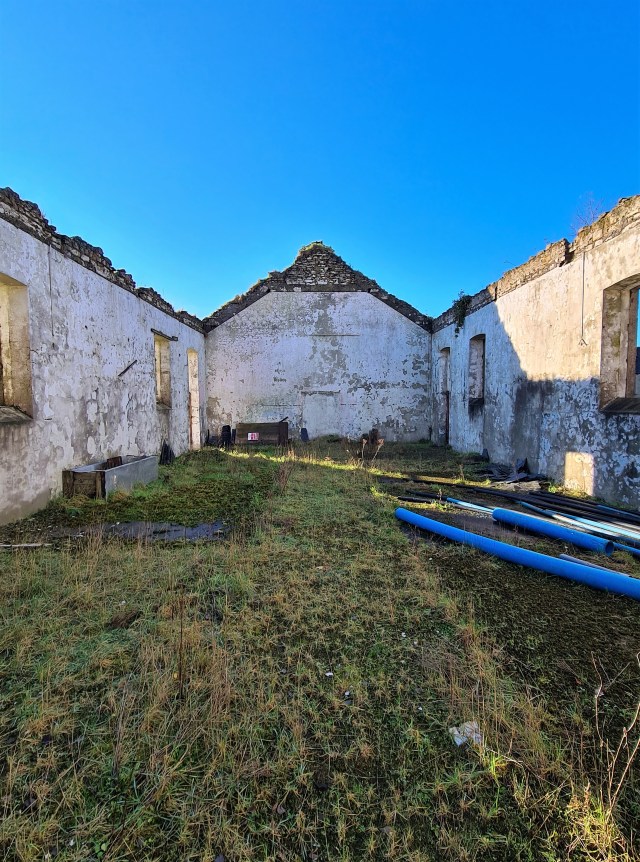


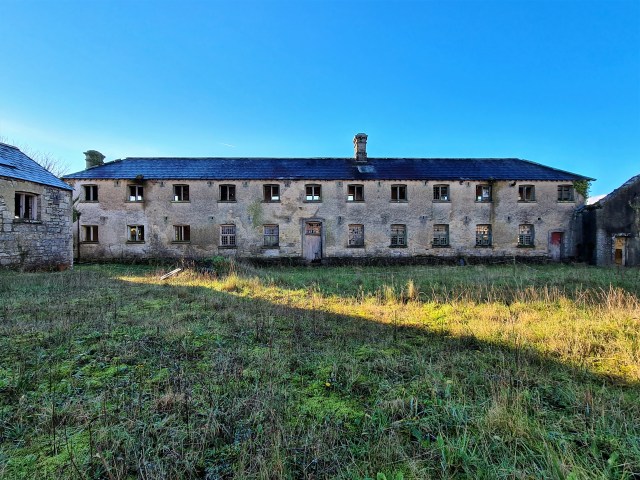
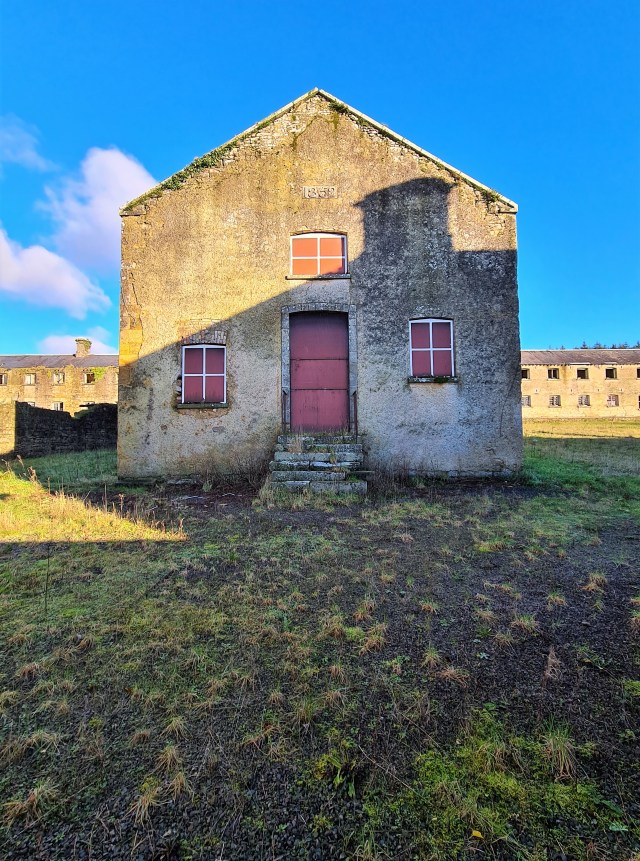
Employed on an annual salary of £500, Wilkinson was instructed by the Poor Law Commissioners to visit and inspect all proposed sites before coming up with a proposal for workhouses ‘intended to be of the cheapest description compatible with durability; an effect is aimed at by harmony of proportion and simplicity of arrangement, all mere decoration being studiously excluded.’ Within a couple of months, Wilkinson had come up with a design model which was almost universally applied in the construction of Irish workhouses. Built of stone in a suitably unadorned Tudoresque style and capable of holding on average up to 800-1,000 persons, each site was entered through a relatively small porters’ block, where prospective inmates were admitted and where the local guardians would hold their meetings. Behind and to either side of this were separate recreation yards for boys and girls, divided by a small central garden. Then came the main accommodation block, separated into dormitories for men and for women (and for boys and girls above), behind which were two further recreation yards, once more divided by gender and kept apart by a long building running down the spine which held the chapel and dining room. Finally, the top of the workhouse site would be occupied by the kitchens, a laundry, a mortuary and what was usually described as a ‘ward for idiots.’  Because they all followed the same model, workhouses soon began to spring up across the country: as early as April 1843, Wilkinson was able to report that 112 of them were finished, and another 18 nearing completion. But they remained deeply unpopular, among all classes. Those who had to pay for them resented doing so: in Westport, County Mayo, for example, although the workhouse was ready for use in November 1842, it took three years – and a change of Board of Guardians – for the necessary operating funds to be collected through poor rates. Meanwhile, nobody wanted to be admitted to places known for their harsh regime, poor diet and miserable living conditions: even in the summer of 1846, many workhouses were only half-full. Then came the worst years of the Great Famine when suddenly there was no alternative. Buildings never intended to meet such demand struggled to accommodate many more inmates than had been planned, disease, such as typhus, became rife, and large numbers of Unions sank into debt as they struggled to provide any kind of assistance to the starving local community. No wonder that the image of the Irish workhouse is forever tainted. And quite a few of them survive to the present day, either in part or whole, and often pressed into service for other uses, not least as hospital complexes: Wilkinson, it appears, met his brief to make them durable. The workhouse shown here, in Bawnboy, County Cavan, is one of those established in the post-Famine period. Simpler in style than the earlier models, it was built at a cost of £4,900 (plus £945 for fixtures and fittings) and opened in November 1853 when 52 inmates from its equivalent in Cavan town were transferred here. Designed to hold 500 residents, it never seems to have reached that figure: in 1855, 172 persons lived here and by 1901 there were just 70. Following the workhouse’s closure in 1921, the buildings were used for various purposes, some of them serving as a vocational school, while another section became a dancehall. Services were held in a Roman Catholic chapel as late as 1979. Then no new function could be found them, and a long, slow decline appears to have begun, despite local recognition of the site’s significance and efforts to save the buildings. This is how they are today, derelict and empty, silent witnesses to a particularly grim period of Irish history.

A Class Fine


-After last Wednesday’s post about a boarded-up church in County Louth, here is a more secular example of similar neglect, this one in Greenore, County Louth. Some 15 years ago, this little seaside village lost its most significant piece of architectural heritage – the Railway Hotel, designed by James Barton and constructed in 1875 for the London and North Western Railway – which was demolished by the port company in order to build a storage warehouse. This smaller building stands close to the beach, and as can be seen once served as a local cafe but has stood boarded up for some time. A Dangerous Structure notice from the local authority can be seen on the facade instructing the owner to carry out repairs to the guttering and slates within 14 days or else risk having to pay a Class C Fine (which is to say, a sum not exceeding €2,500). The notice has been in place since February 2021.

A Sorrowful Sight


A sorrowful sight: one of the few Penal era Roman Catholic churches left to moulder. This Holy Trinity in Kildoagh, County Cavan, a rare surviving example of such barn-style places of worship more often associated with the Presbyterian faith. A stone plaque on the front notes in Latin that it was constructed in 1796 by the Reverend Father Patrick Maguire. At that time, the building would have had a thatched roof, but this was replaced by slate in 1860 when an additional bay was added and the facade refenestrated. There are separate entrances for men and women, who were also seated in separate galleries on either side of the altar. The church was closed for services in the late 1970s and seemingly suffered from vandalism, hence its present boarded-up condition.


No Longer Triumphal


A former entrance to the Rathfarnham Castle estate in County Dublin. Constructed of granite and taking the form of a triumphal arch, the building’s design according to James Howley (in his 1993 book The Follies and Garden Buildings of Ireland) was inspired by the Porta Portese in Rome: both share a number of features including engaged Doric columns, square recessed panels above niches, and a balustraded top above the arch. One obvious difference is that inside the Rathfarnham entrance can be found a keystone made from Coade stone and representing a hirsute Roman God. When Howley was writing, the architect responsible for this work was unknown, but more recently in his Gazetter to the Gate Lodges of Leinster (2016) J.A.K. Dean has proposed Francis Johnston, the design based on James Wyatt’s entrance to Canterbury Quad, Christ Church College, Oxford: Dean points out that Johnston’s early patron, Richard Robinson, Archbishop of Armagh, was a graduate of Christ Church and had provided the funds for the rebuilding of Canterbury Quad. Alas, despite such a distinguished pedigree, today the Rathfarnham arch languishes neglected on a tiny strip of land, surrounded by housing estates and intermittently subjected to vandalism. It deserves better than this: why might it not be moved into the grounds of Rathfarnham Castle, which would provide a safer home than is the case at present.


Towering Over its Surroundings


The surviving walls of Garron Castle, County Laois. Dating from the late 16th century, it was originally built by the Mac Giolla Phádraig (FitzPatrick) family, possibly in the time of Brían Óg Mac Giolla Phádraig, who in 1541 was created first Baron Upper Ossory, or else his son Barnaby FitzPatrick, second baron, who became a close companion to the boy king Edward VI before returning to Ireland after the latter’s death in 1553. The six-storey tower house remained in the possession of the FitzPatricks until the mid-17th century when it appears to have passed into the possession of the Vicars family. A view painted in 1790 by Austin Cooper shows it still reasonably intact, but in 1863 it was reported that two walls had collapsed, leaving the remains seen here, with a round bartizan on the top of one corner and a corbelled bartizan lower down the wall. Today Garron Castle towers over a farm yard adjacent to the present owners’ bungalow.


The End is Nigh


The former woolen mill at Ardmayle, County Tipperary, built by the banks of the river Suir around 1800. The man responsible was Richard Long who when young had joined the ranks of the East India Company where he rose to the rank of captain. He also succeeded in making himself wealthy so that on his return to Ireland in 1783, he was able to buy an estate in his native county and there built a house which he named Longfield. Unfortunately he made himself unpopular in the area by reporting suspicious activity to the local authorities and in 1814 was shot dead on the steps outside his new home. The mill was one of the enterprises he started in the locality, but it does not appear to have enjoyed much success, and as can be seen, more recently at least part of the ground floor was converted into a shop. But now the building has fallen into dilapidation and it can only be a matter of time before the rest of the roof goes and complete decay takes over.


A Familiar Sight


A familiar sight across the country: an abandoned and roofless Church of Ireland church. This one is in the parish of Kilfree, County Sligo and, according to the reliable Samuel Lewis’s Topographical Dictionary of Ireland of 1837, was ‘erected in 1826, for which the late Board of First Fruits granted a loan of £600.’ It appears to have closed for services in the 1950s, but as so often the surrounding graveyard remains in use.


An Act of Folly


Situated to the immediate north-west of Dundalk, the Dún Dealgan Motte is associated with a number of myths, one of them being that this was the birthplace of the Irish legendary hero, Cúchulainn. Around 1180, the Normans were responsible for creating the present substantial earthwork which consists of a flat-topped mound some ten metres above the surrounding countryside, encircled by a deep fosse with a diameter of around 97 metres. It is likely that a wooden fortification was then erected on the top of the site, but this has long since vanished. Towards the end of the 18th century, a local merchant called Patrick Byrne (sometimes described as a ‘pirate’ since he may have been involved in smuggling) erected the castellated tower that can be seen today. Although damaged in the 1798 rebellion, it remained standing and around the mid-19th century was further enlarged and embellished by Colonel Thomas Vesey Dawson as a country retreat. However, the building subsequently fell into disrepair before being burnt out in the 1920s, leaving just a ruin of the tower, commonly known as Byrne’s Folly.